

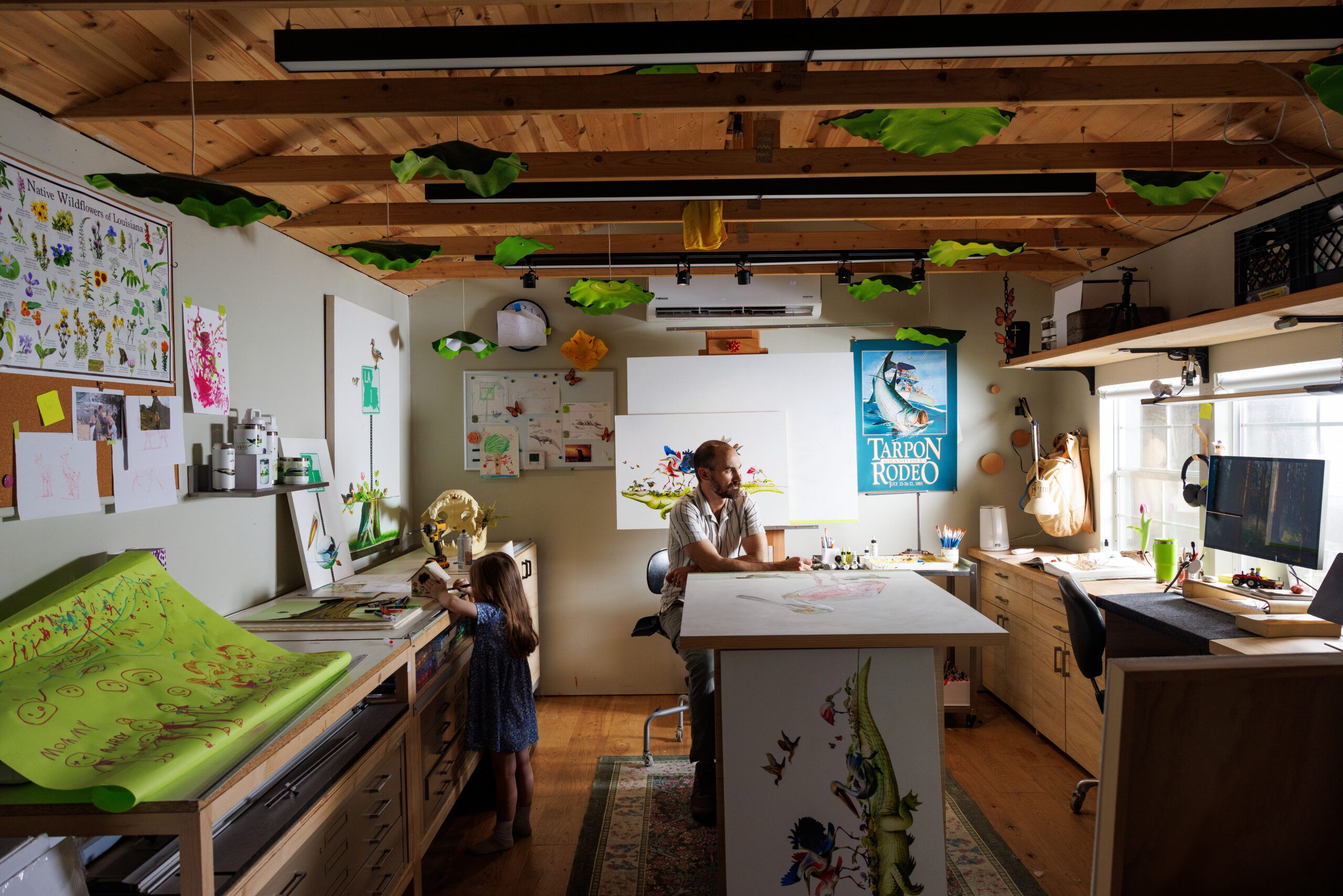
Where the Wild Things Art: Adventures in painting and parenting with Chase Mullen
From French Impressionist Pierre-Auguste Renoir rendering now-classic playtime portraits of his sons, to TikTok sensation Stephen Spencer turning his toddler daughter’s rambling stories into viral pop anthems, artists of all stripes have long drawn inspiration and a consistent collaborative verve from their children.
Baton Rouge’s boldest naturalist painter, Chase Mullen, is no different—only his fatherly explorations involve a lot of dirt, headlamps and digging tools at dusk.
And critters. There are always critters.
“Adventure, for now, is scaled down a bit,” says the husband and father of two preschoolers who likes camping, but loves connecting his children, Audrey and James, to the wonders of nature even more. “Thankfully, they’ll run around the park and dig in the backyard still. It’s amazing, suddenly you can see a whole other world within a cubic foot of earth.”
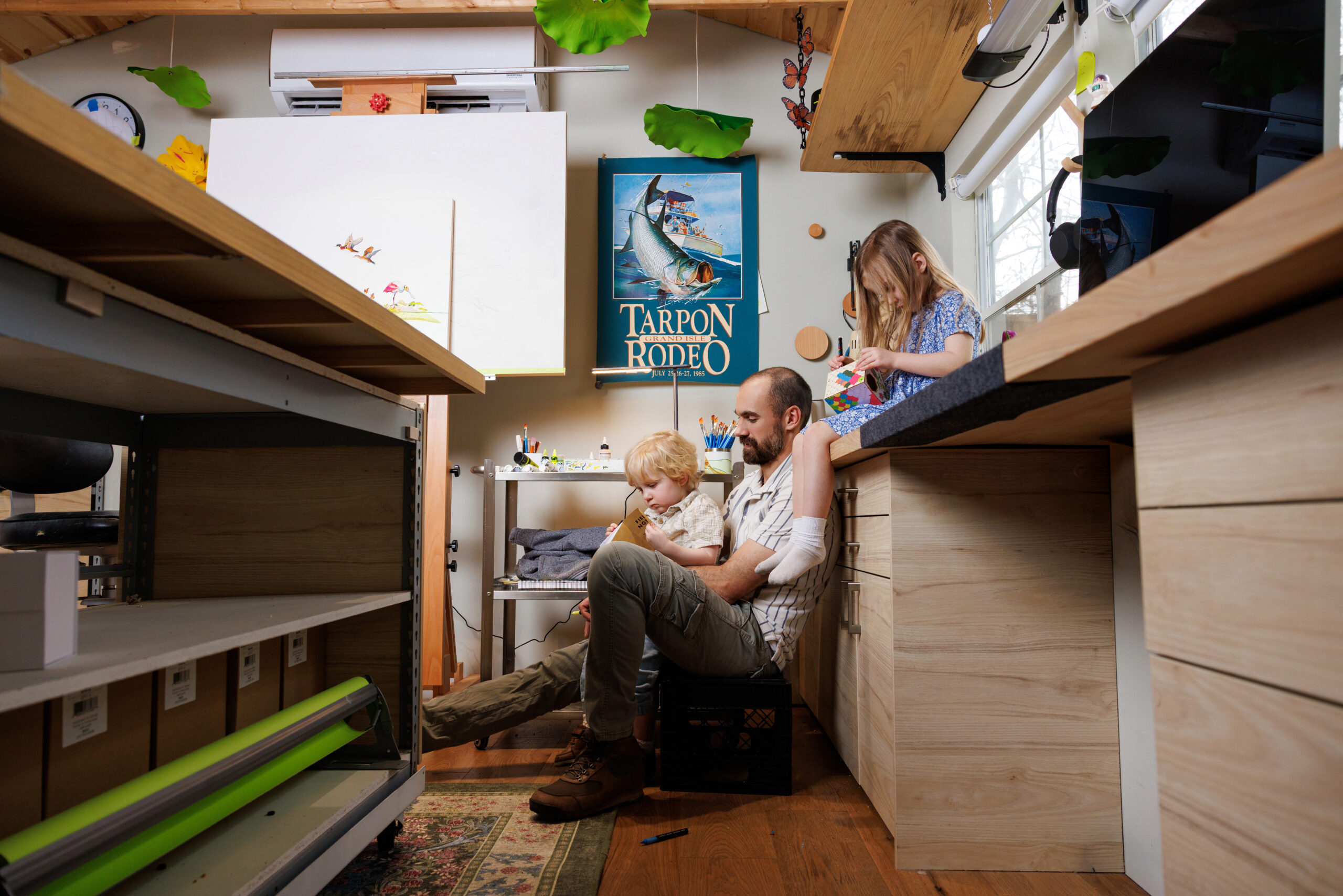
For more than a decade now, Mullen has been pulling viewers into new worlds on his canvases, marked by Louisiana-inspired wilderness scenes kissed with an intricate and idyllic charm.
Stare long enough, and you almost expect these animals to talk.
“A lot of Louisiana depictions can be cliché—oh, here’s another egret or another pelican—but the way Chase uses the natural world to reflect his own personal experiences is so magical and curious, and just lovely,” says Beth Welch, assistant curator and museum preparator at Louisiana Art and Science Museum. “We let him pick his gallery space at the museum, essentially gave him a white box, and told him he could do whatever he wanted.”
For a museum to pay any attention to a self-taught artist in his hometown is a rarity, but the staff at LASM had admired Mullen’s work for years when they approached him for a collaboration that turned into March 2024’s hugely popular show.
“A lot of Louisiana depictions can be cliché—oh, here’s another egret or another pelican—but the way Chase uses the natural world to reflect his own personal experiences is so magical and curious, and just lovely.”
—Beth Welch, assistant curator and museum preparator at Louisiana Art and Science Museum
“The more specific my work gets, people seem to respond to it more,” says the artist who ships commissions the world over and has shown in Miami and Los Angeles galleries. “Which is counterintuitive to the concept of mass appeal, but it’s so true. If you get crazy specific, it actually connects with more people in a deeper way.”
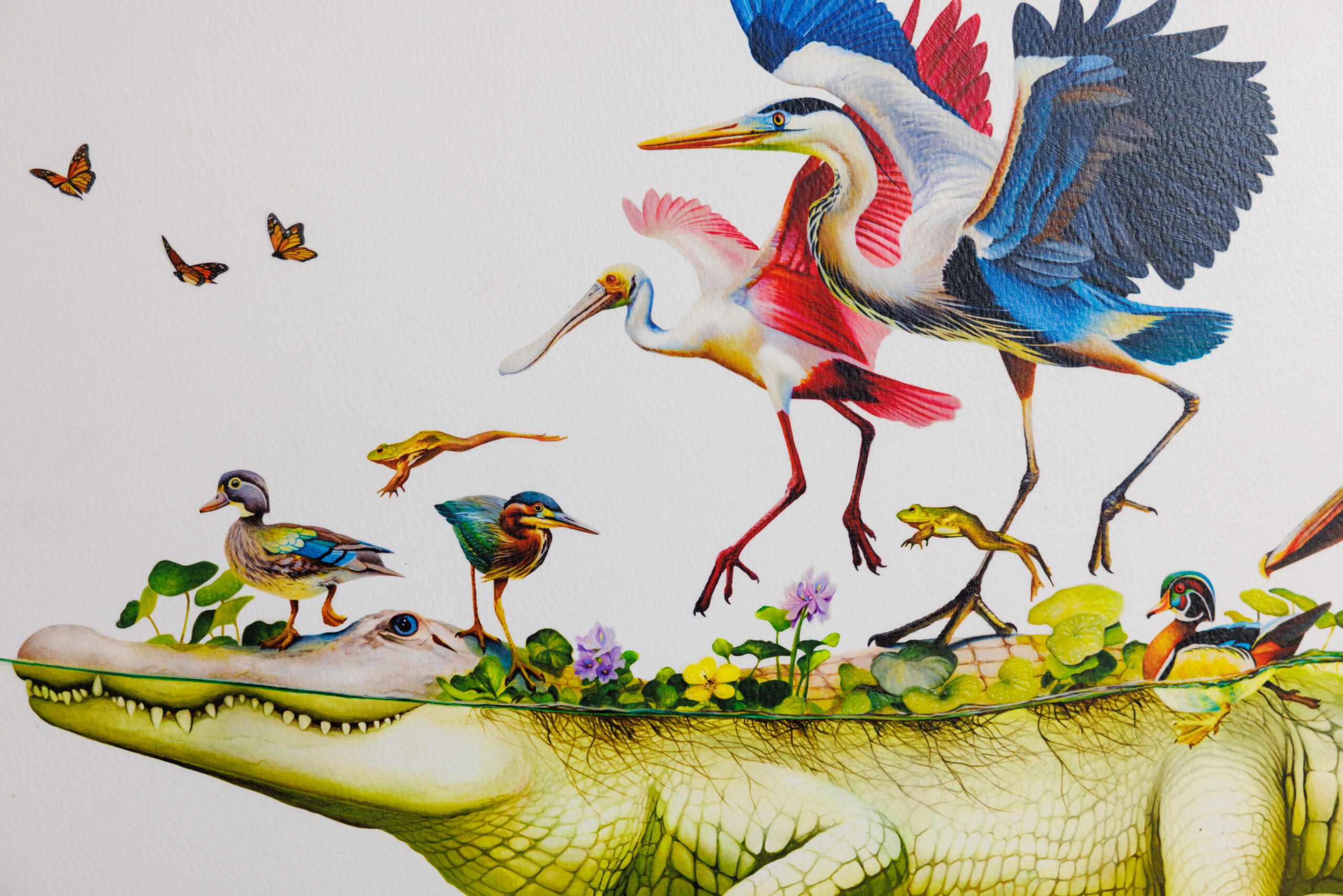
Both anatomically accurate and surreally vivid, his paintings reflect his outer world and, increasingly, his inner world, too. Some keen observers and collectors first guessed Mullen and wife Cheryl Pigion were adding to their family when an egg and a second young animal became recurring motifs.
“After having kids, the work has become more like a journal, a diary of life,” Mullen says, scrolling past two young squirrels rocketing after each other as bedtime-escaping toddlers might. “There’s a lot of allegory in it all. That’s the way things have progressed.”
On multiple levels, his work embodies everything LASM is about—Louisiana, art and science—which made his show a perfect fit.
“He’s really taking Louisiana things and elevating them,” says Tracey Barhorst, LASM’s lead curator and director of art programs. “And there’s no age to it, no gender or group, it’s really artwork that everyone can find joy in. The Audubon Institute praised the detail of his work, but the most exciting thing for Chase, I think, was seeing young children at his show become completely fascinated with wildlife.”
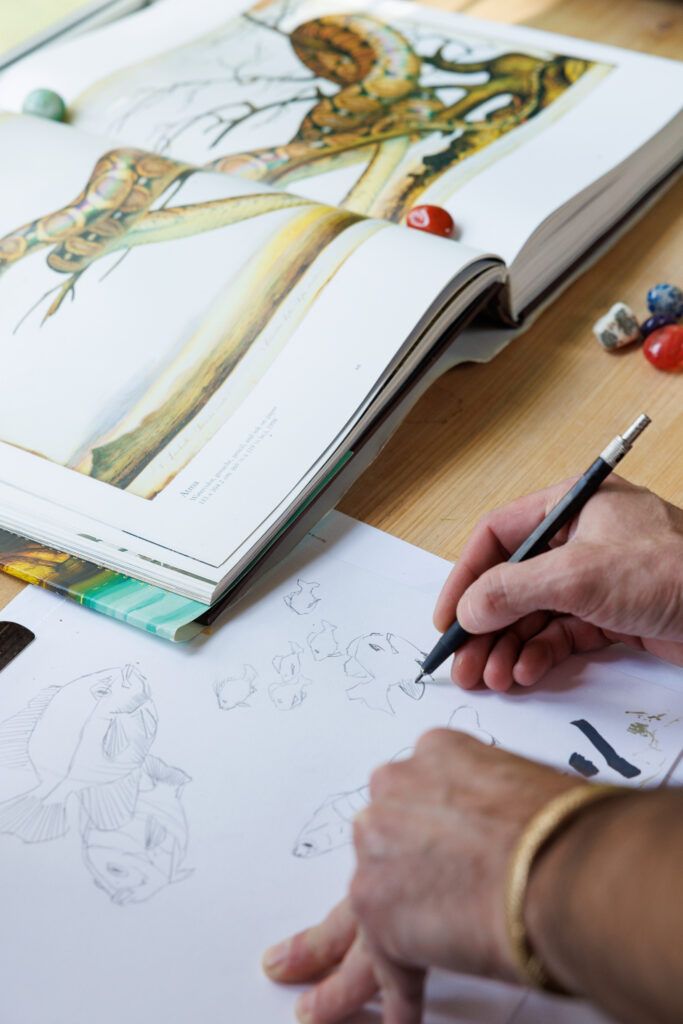
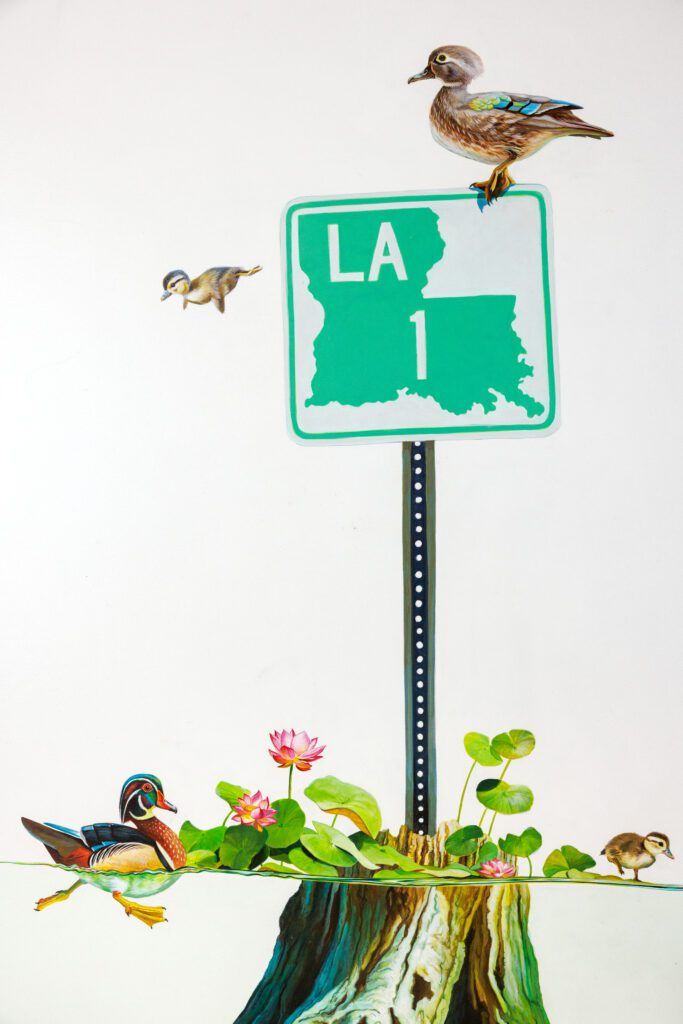
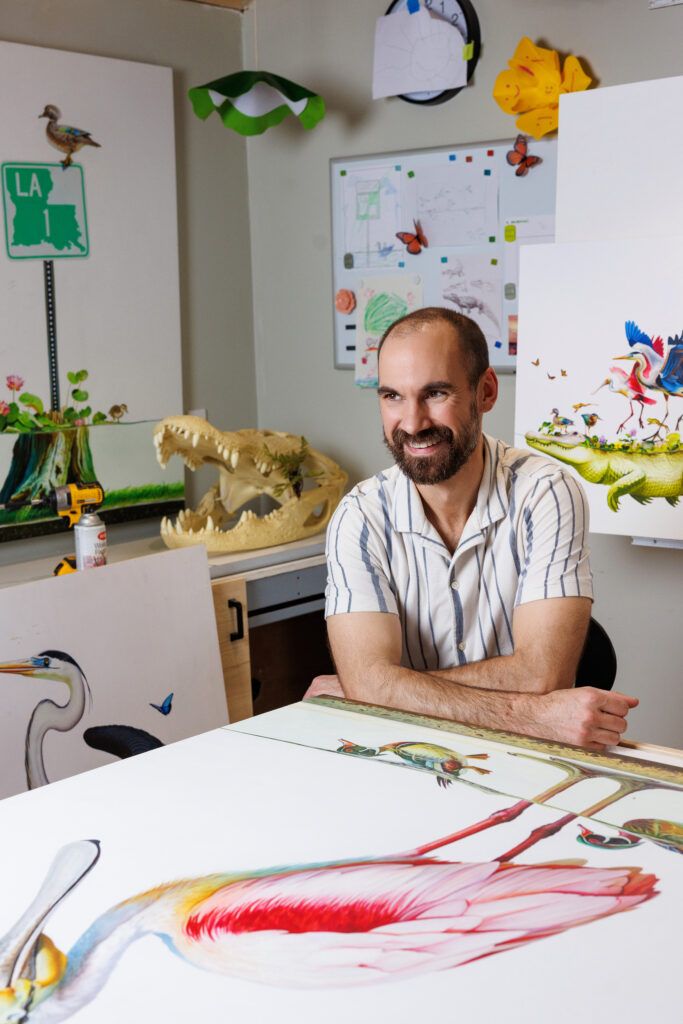
When choosing the animals to paint, Mullen uses the term “casting.” Not like a rod, but like a role. The baseline for his paintings isn’t neutrals. It’s narrative. He recently rendered a colorful wood duck because the water-treading birds’ dives out of their nests reminded him of his fearless young daughter launching herself off a footbridge at their favorite park.
“The story always comes first, really,” Mullen says, circling a large work table stacked with pencil sketches, a YETI mug emblazoned with his work, and a newly-primed canvas—a massive alligator skull looking down from the top shelf—“It’s based on our experiences as a family, and how I can translate that visually within my style.”
This is more than painting; it’s myth-making, as Mullen commands the mighty forces of the wilderness with a new call to perform their own verse, as Walt Whitman once put it, the powerful play goes on.
Mullen and Pigion’s story almost took a very different turn. An educator, Pigion was teaching in China for three years when the pandemic hit in late 2019. She was also pregnant with their first child.
With international travel virtually locked down, it took some passport and work visa maneuvering, and an epic 25-hour drive to Shanghai to get the couple on a plane back to the United States.
Just a few months later, their daughter was born in Louisiana.
“That’s really when it started, when he began showing more animals guarding their little ones,” Pigion says. “I think he’s personally a lot more visible in his work now, and since our son was born, especially. He’s become very intentional with it.”
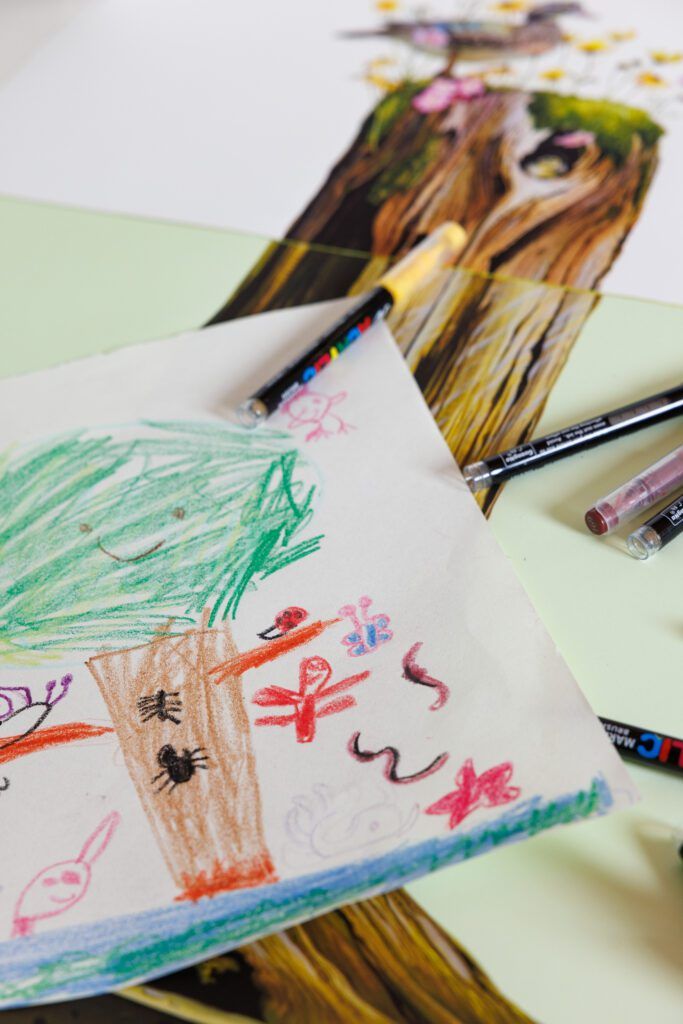
Inspired by pioneers, cartographers and pre-camera naturalists who studied the flora and fauna of a much wilder North American continent, Mullen has had to hone his edgier interests into the more modern work/life balance of a parent and a painter.
“I’m like a shotgun,” Mullen says. “I like to line everything up, and then just go, go, go.”
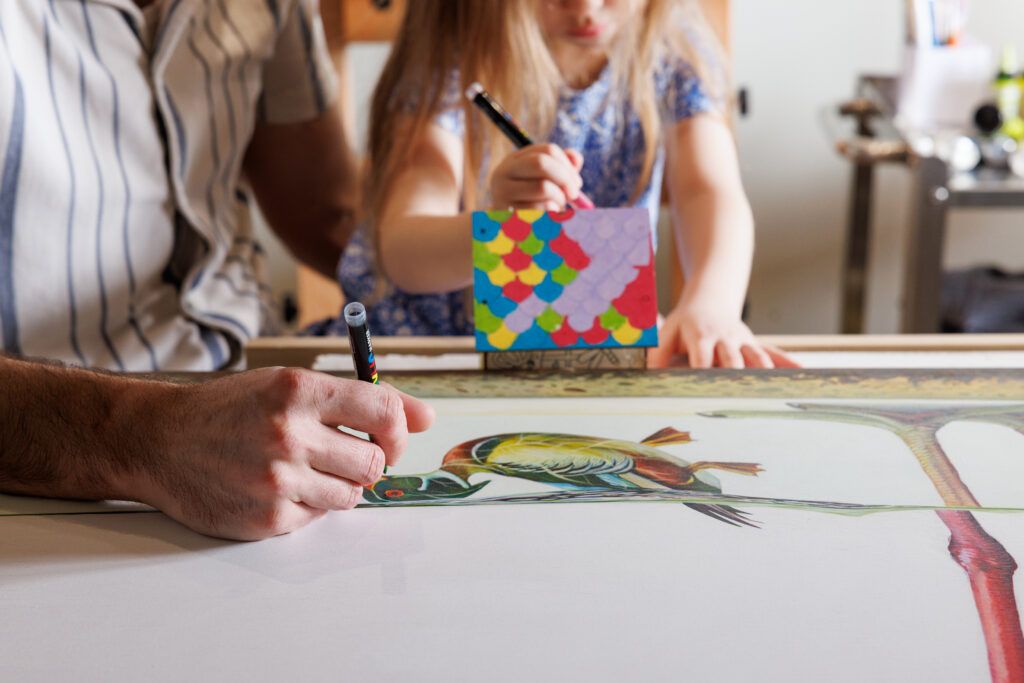
Organized to the gills—his sketches look like finished works, his notes and brainstorms like architectural drafts—he prefers marking his territory as an artist with clear boundaries. Only when his dad duties are done or delegated will he deep dive into several days of creating. Even then, his daughter will find him late at night in his backyard workshop, when she can’t sleep and sees his lights are on. That’s when new, and adorable, collaborations begin.
“She’s a carbon copy of Chase,” Pigion says. “And he doesn’t function like other humans; he’s on another cycle. He’ll paint for two full days straight, all-nighters, and then rest later. It’s like his body has no idea where the sun is at any given time.”
Artist and graphic designer Thomas Wimberly III agrees. Mullen calls him his sounding board for ideas, and Wimberly served as art director for the Los Angeles studio of iconic street artist and activist Shepard Fairey. But before he did that, he waited tables in Baton Rouge with Mullen, and the friends rented a warehouse space where they both honed their craft.
“Just having this big playground to share with one of your best friends, and to have his unique perspective on my art and vice versa, it was a really influential time for me,” Wimberly says. “Chase works harder than just about anyone I know, and I’ve seen him juggling different things at the same time—like the more mundane stuff of being an artist, emails and packaging—with being in a complete flow state on a painting.”
Art entrepreneurship is a difficult balancing act, like parenthood, or working abroad, but Mullen and Pigion are thriving in those woods.
“As long as the bills are paid and the clients are still interested in commissions, I feel like I can explore a lot more,” Mullen says. “I really wonder what the next metaphor is going to look like?”
Flowers bloom again, but a child will never be a child again.
Mullen wrote that Chinese proverb like an equator line across his studio whiteboard populated with sonogram pictures, Polaroids, stickers and notes.
He knows this time in his family’s life is precious. Maybe that’s why his work feels timeless.
So, what’s the next step on the path?
“Doing anything to keep the kids off screens,” Mullen says. “We love Fort Pickens in Florida, and Chicot State Park, and at their age, any camping is a big experience. But really, adventure can be anywhere.”
The artist points out the window to his yard, where a few giant stalks of verdant palm fronds and dandelions shimmer and stand tall like Willy Wonka props in the dappled afternoon sunlight.
Mullen has been experimenting with an insulation foam he shapes and colors in lifelike textures with the aim of creating immersive sculptural environments based on his paintings. Exploration is leading him into a third dimension, and soon his audience could follow.
“I can see some creative runway there,” Mullen says. “Other than those taking over the studio soon? Honestly, there’s probably going to be a big pile of LEGOs.”
Select paintings, prints and custom YETI mugs are available at The Foyer. Mullens’ latest work can be viewed at @chasemullenstudios on Instagram and chasemullenstudios.com.