



We chant ‘Geaux Tigers’ at games. But why did we start spelling the word ‘go’ with some cajun flair?
One Louisiana 93-year-old believes he’s the reason we all say “Geaux Tigers.”
Frank Carr’s love for LSU first ramped up when his family got a battery-powered radio. Each week, the boy would fiddle with the dials, tuning into the play-by-by commentary.
After high school, Carr worked on his father’s farm but decided to enroll at LSU for a short time from 1951 to 1953. He’d only experienced football games with his ears before, but he was finally able to attend and see the action.
Besides his affection for sports, Carr says he had a fondness for “tinkering with words.” With his newfound social life at college, Carr went on to meet new people—including a few Cajuns, which sparked some of that word tinkering.
“That ‘eaux’ at the end of so many names fascinated me,” he says. “I stuck that in the back of my mind.”
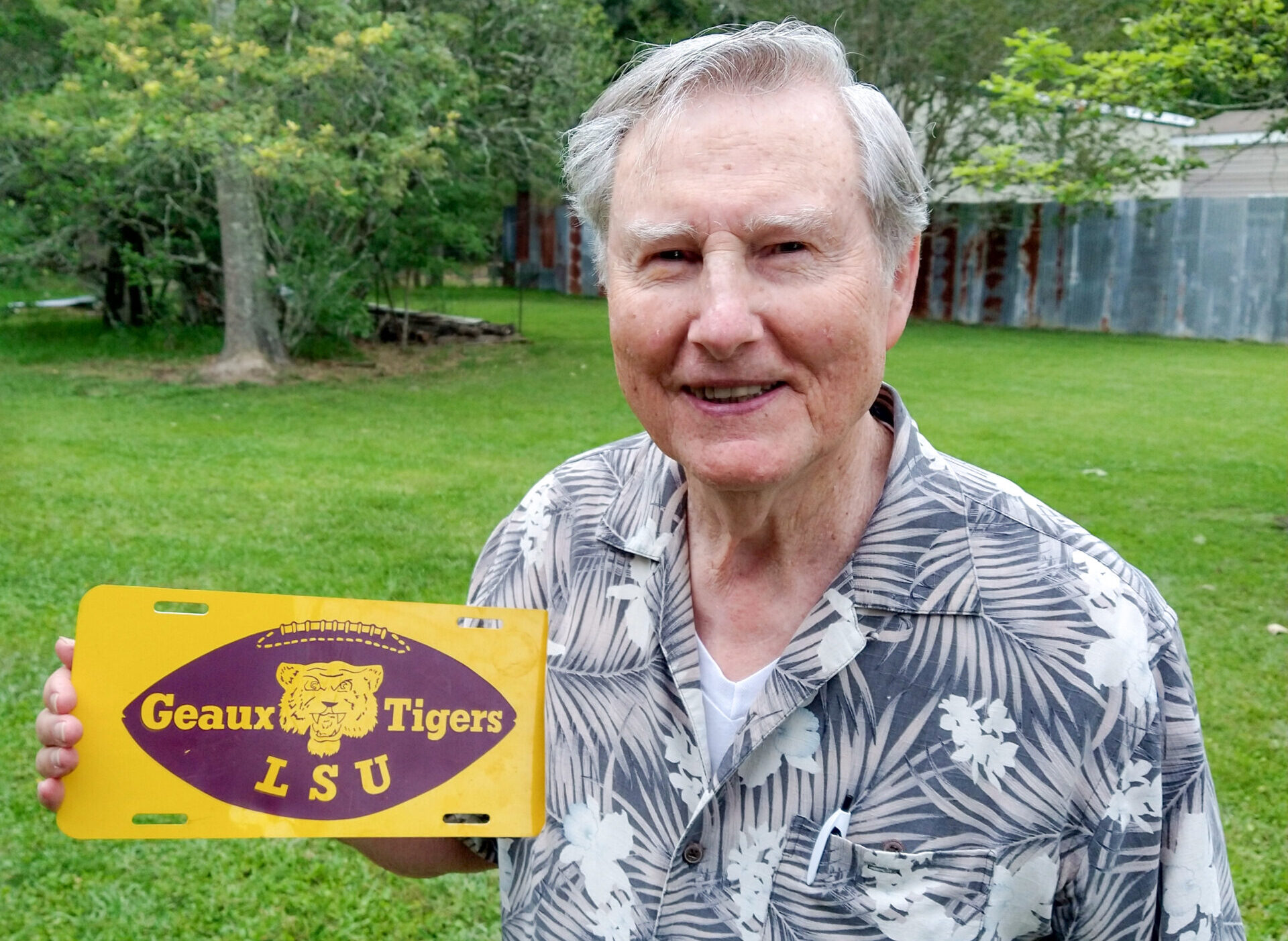
But when he first thought about applying “geaux” to expressions about the Tigers, Carr didn’t tell anyone about it. That is, until, the late ’60s, when he revealed the idea to a friend he was working alongside at the Louisiana Department of Transportation and Development. Hoping to make a little extra cash on the side, Carr’s buddy was plotting an LSU-themed license plate that fans would be able to display on their front bumpers.
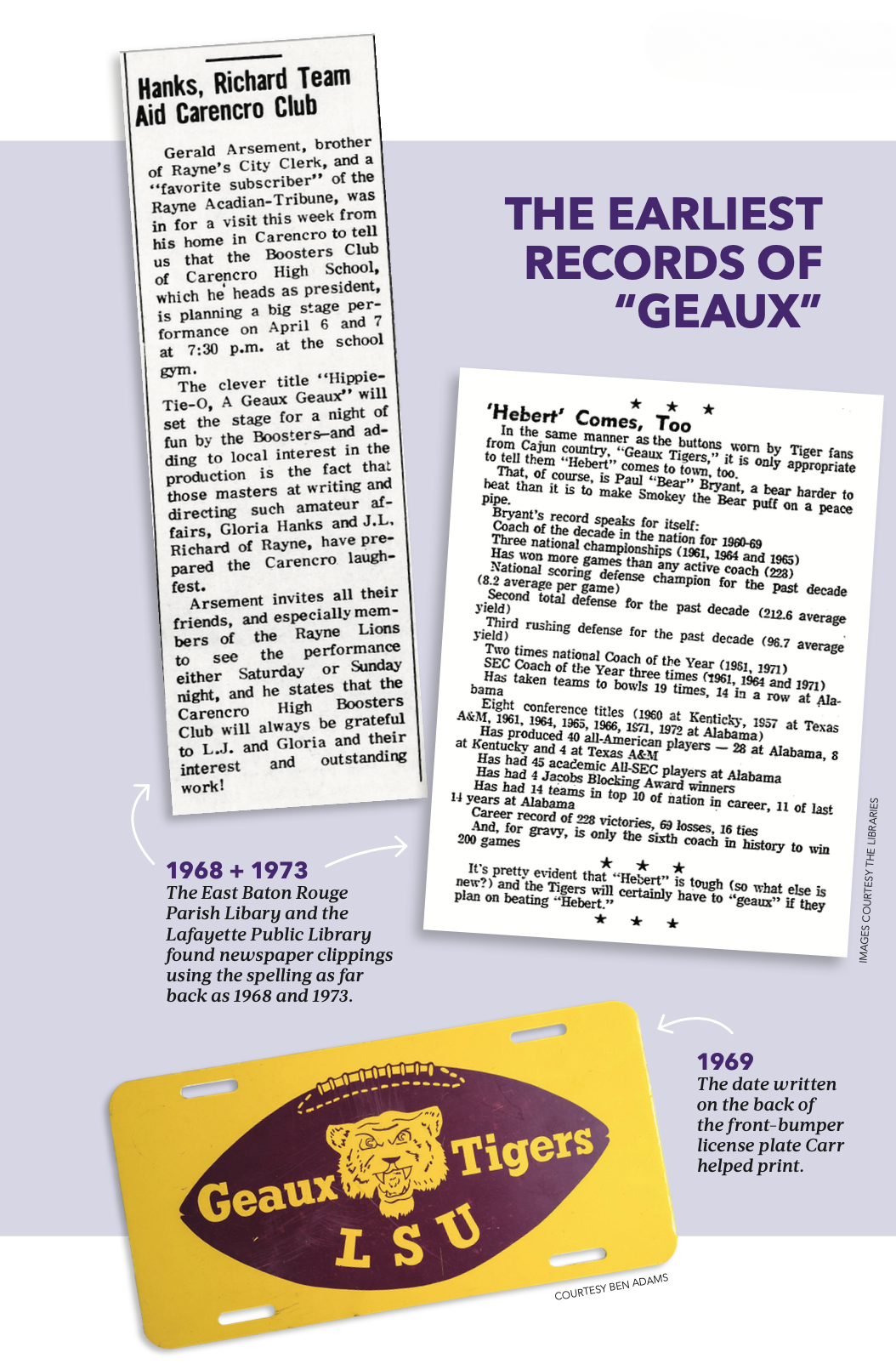
The design was a yellow plate with a purple football and a tiger in the middle. Carr thought “Go Tigers” looked unbalanced, with a two-letter word on one side of the illustration and a six-letter one on the other. So, he suggested his special spelling and helped print two sample plates. One said “Go Tigers,” and the other read “Geaux Tigers.”
At first, he says his friend thought it was “too strange” a spelling but ultimately decided to go with “geaux.” A small set of plates was printed and distributed at local shops. Carr doesn’t quite remember the year the plates came out, though his original plate has 1969 written on the back.
“I lived in north Baton Rouge and (while) in traffic, I’d look for cars with the plates,” he says. “Finally, I saw one and saw a couple more. Then, I didn’t see one for a long time. But, then (my word) showed up later in Tiger Stadium scrolling across the screen. And that was a real thrill.”
“Geaux” had entered the public domain.

Eventually, “Geaux Tigers” would be trademarked by LSU. In the 337, “Geaux Cajuns” is trademarked by the University of Louisiana at Lafayette.
Is it all thanks to Carr? 225 enlisted the help of regional libraries to help vet the word’s origins.
Both the East Baton Rouge Parish Libary and the Lafayette Public Library traced the first printed record of “geaux” back to 1968. A clipping from the Rayne Acadian-Tribune referenced “geaux” in a stage show title that was unrelated to LSU Athletics. This was only one year before the date printed on the back of Carr’s license plate.
Given the geographic distance between Rayne and Baton Rouge, as well as the slower speed that slang spread in the pre-internet era, it’s difficult to imagine the 1968 and 1969 usages were connected.
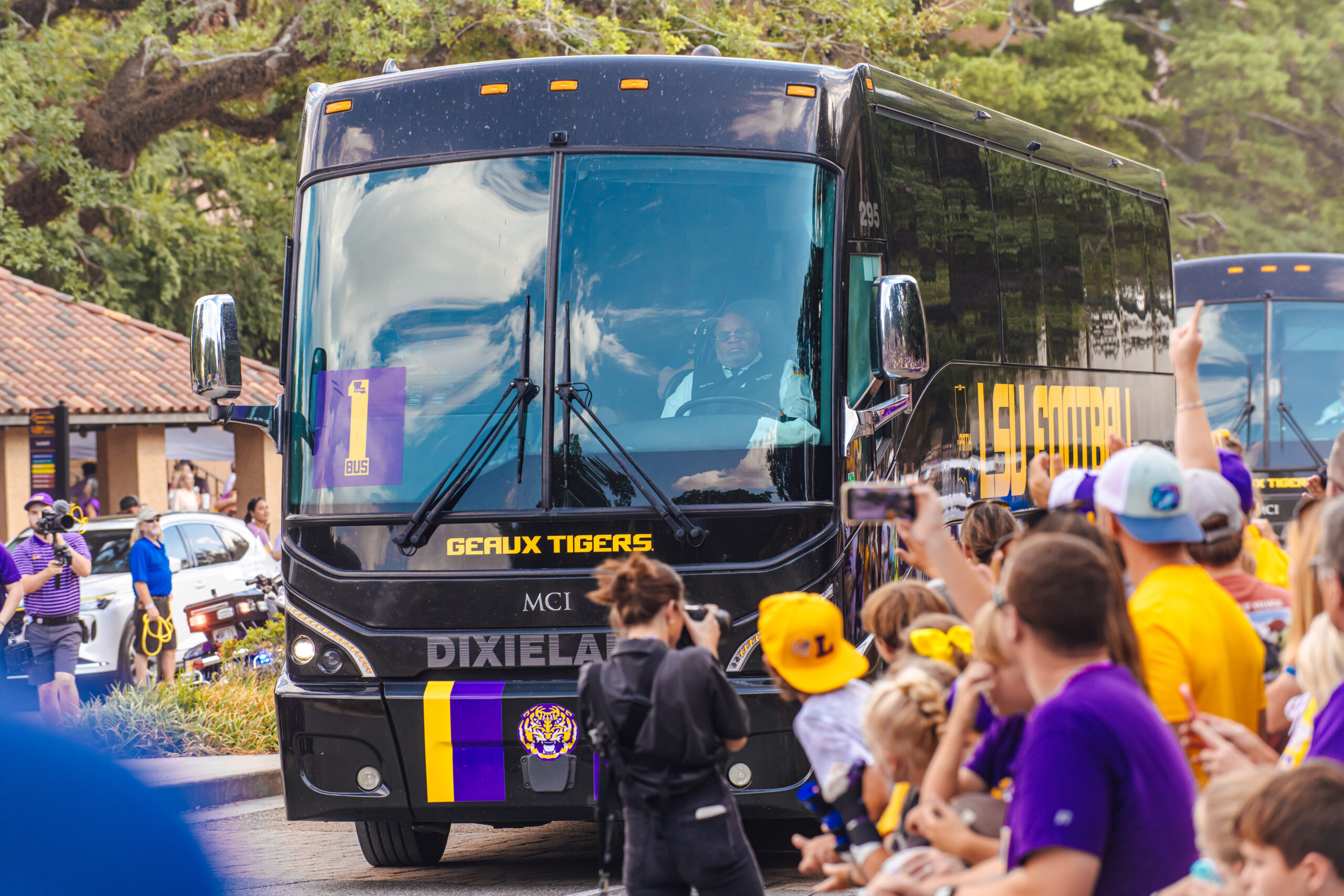
“Geaux” was seen a few years later in the State Times Advocate. A clipping from 1973 provided by the East Baton Rouge Parish Library used the fan expression “Geaux Tigers,” which by then seemed to have caught on with LSU’s Cajun crowd.
Was it Carr’s license plate expression that sparked the word’s initial popularity among Tiger fans?
It’s hard to say for sure, but Carr has no doubt his contribution was one of the very first.
Carr now resides in Denham Springs with family close by in the Capital Region. He remains a die-hard Tiger fan.
He says though he’s never made money from the word, he still loved seeing it catch on with the team he grew up rooting for by his radio.
Today, he owns multiple pieces of LSU merchandise with the word “geaux” printed on them.
But, none seem as special as that mustard-colored front bumper plate from 1969.
“The ‘geaux’ spelling, I thought, was something that would not be understood or appreciated by even the craziest of Tiger fans,” he says. “I was wrong.”
Now, that’s worth a “Geaux Tigers.”

This article was originally published in 225 Magazine’s 2024 Tiger Pride edition.